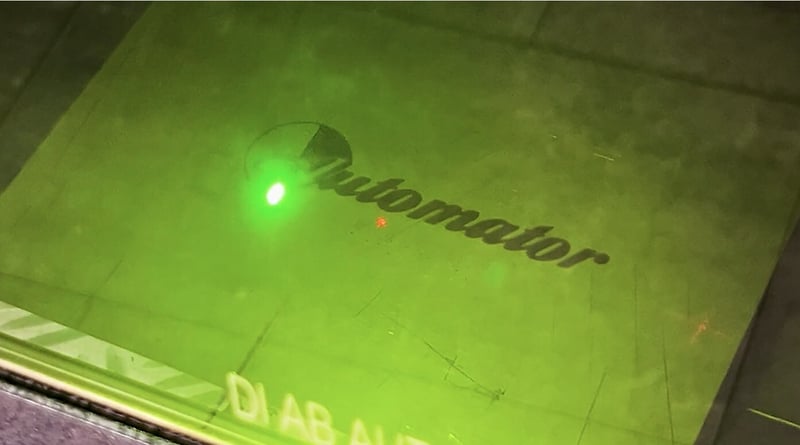
Laser Classes: how they work and what they mean for your company

If you are considering buying a laser marking machine, sooner or later you will have come across a label such as "Class 1" or "Class 4" on the machine's data sheet. It is information that has a real impact on how you will need to manage that machine in production.

In this guide you will find:


laser classes automator

What are laser classes?

The laser class is a safety label, defined by the international standard IEC 60825-1, that indicates how dangerous the beam emitted by a machine is to the eyes and skin of people working near it. It ranges from Class 1 (virtually no risk) to Class 4 (the highest level).

The class is a direct result of how the machine is built. A laser source, on its own, is almost always Class 4. It becomes Class 1 only if it is enclosed in a cabinet that physically prevents the beam from escaping during normal use.

This detail determines whether you will need to set up a dedicated area, train operators, buy protective equipment or appoint specific roles in your company. In other words, it affects the real cost and complexity of managing the machine, not just the purchase price.


Laser classes one by one

Here is an essential summary of the laser classes you will come across most often in industrial marking:
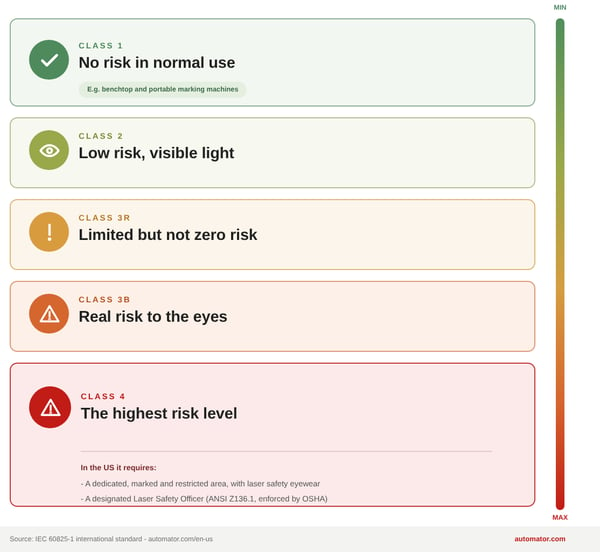
  • Class 1 – the safest. No risk to eyes or skin in normal use, no protection required.
  • Class 2 – low-power visible lasers (e.g. laser pointers). Hazardous only if you deliberately stare into the beam for a long time.
  • Class 3R – low but not zero risk: prolonged exposure, especially through optical instruments, can be harmful.
  • Class 3B – a real eye hazard even from brief direct exposure; requires specific precautions.
  • Class 4 – the highest level. It can injure eyes and skin and, in some conditions, ignite materials. This is the class of laser sources used for industrial marking, cutting and welding when they are not enclosed.


laser-classes-infographic


Class 1 vs class 4: the practical differences

In industrial marking, in practice, the two extremes that matter most are Class 1 and Class 4: they are the ones that decide which machine you choose. Here is what concretely changes in production:

Aspect

Class 1

Class 4

Operator risk

None in normal use

High: eye and skin injury, fire risk on cellulose-based materials

Where it can be installed

Anywhere, including open shop floors

Only in a dedicated, marked and restricted area

PPE required

None

Laser safety eyewear, protective clothing if needed

Operator training

No specific laser safety training required

Mandatory, covering laser hazards

Regulatory requirements (US)

No additional requirements

Hazard evaluation and a designated Laser Safety Officer under ANSI Z136.1

Typical use

Small to medium batches, workbenches, lines shared with other processes

High throughput, integration into dedicated lines


What US regulation require for a Class 4 laser

If your company has (or is about to buy) a Class 3B or Class 4 machine, ANSI Z136.1, the safety standard OSHA enforces through the General Duty Clause, sets out a number of obligations for the employer:

  • assess the risk associated with laser use;
  • provide suitable personal protective equipment (PPE);
  • train operators;
  • designate a Laser Safety Officer (LSO) to monitor and enforce the control of laser hazards, as required by ANSI Z136.1.

These steps require time, training and, in some cases, the involvement of an outside consultant. It is worth factoring them in when you choose the machine.


The advantages of a Class 1 laser machine

Choosing a Class 1 laser marking machine means moving all this risk management upstream, directly into the machine design. In practice:

  • no dedicated area to set up on the shop floor;
  • no specific laser safety training for operators;
  • no PPE to buy and enforce;
  • the machine can sit in departments shared with other processes.

A special, less common case is the portable Class 1 laser marker: without a fixed enclosure, a handheld machine rarely reaches this safety level. Automator makes Colibrì, a portable Class 1 laser marker, designed to mark directly on the part, even large or fixed parts, without setting up a protected area.

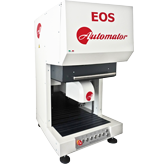
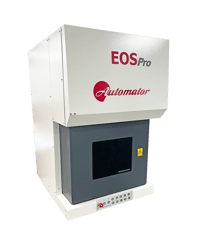
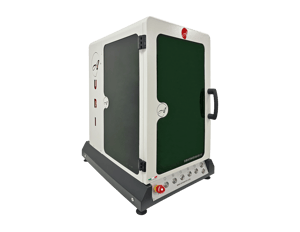
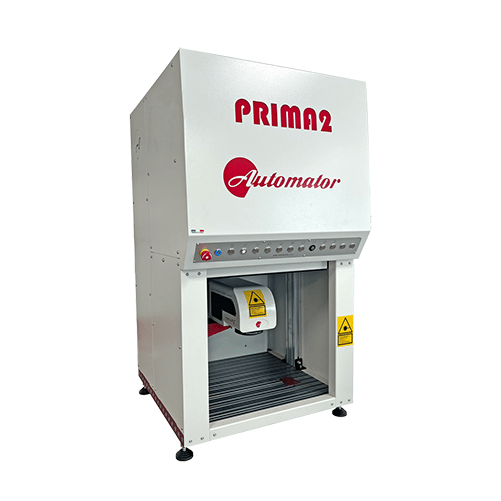
In the benchtop and cabinet range, Class 1 is also available on EOS, EOS Pro, UBI Basic, PRIMA2 and AURA.


EOS – Class 1 laser safety system

EOS – Class 1 laser safety system

EOS Pro – Class 1 laser safety system

EOS Pro – Class 1 laser safety system

 UBI Basic - Laser marking system in Class 1

UBI Basic - Laser marking system in Class 1

Laser marking system PRIMA2 Class 1

Laser marking system PRIMA2 Class 1

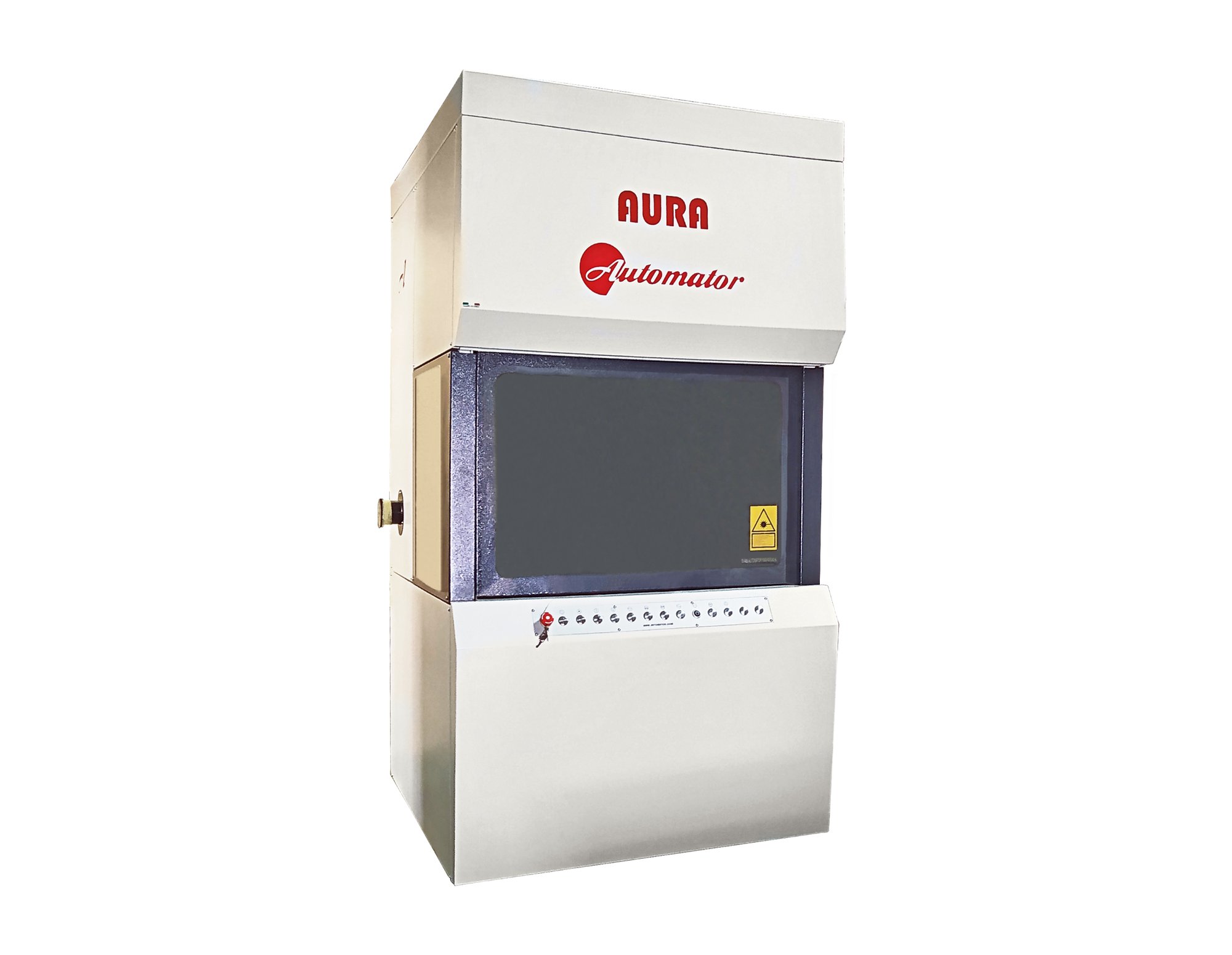
Laser marking system AURA Class 1

Laser marking system AURA Class 1

When you need a Class 4 laser

Class 1 is not always the most suitable choice. There are situations where a Class 4 source (integrated in-line, without a full enclosure) remains the most efficient solution, for example:

  • high-speed production, where cycle time is the priority;
  • custom integration into existing automated lines, working with robots or PLCs.

In these cases, safety management (dedicated area, PPE, training) is part of the integration project from day one.

In the Automator range, this is the segment of Class 4 laser marking machines such as NANOVIS3, VISII, GREENVISII and FYBRAII, all equipped with a dual-channel mechanical safety shutter that reduces residual risk even in Class 4.


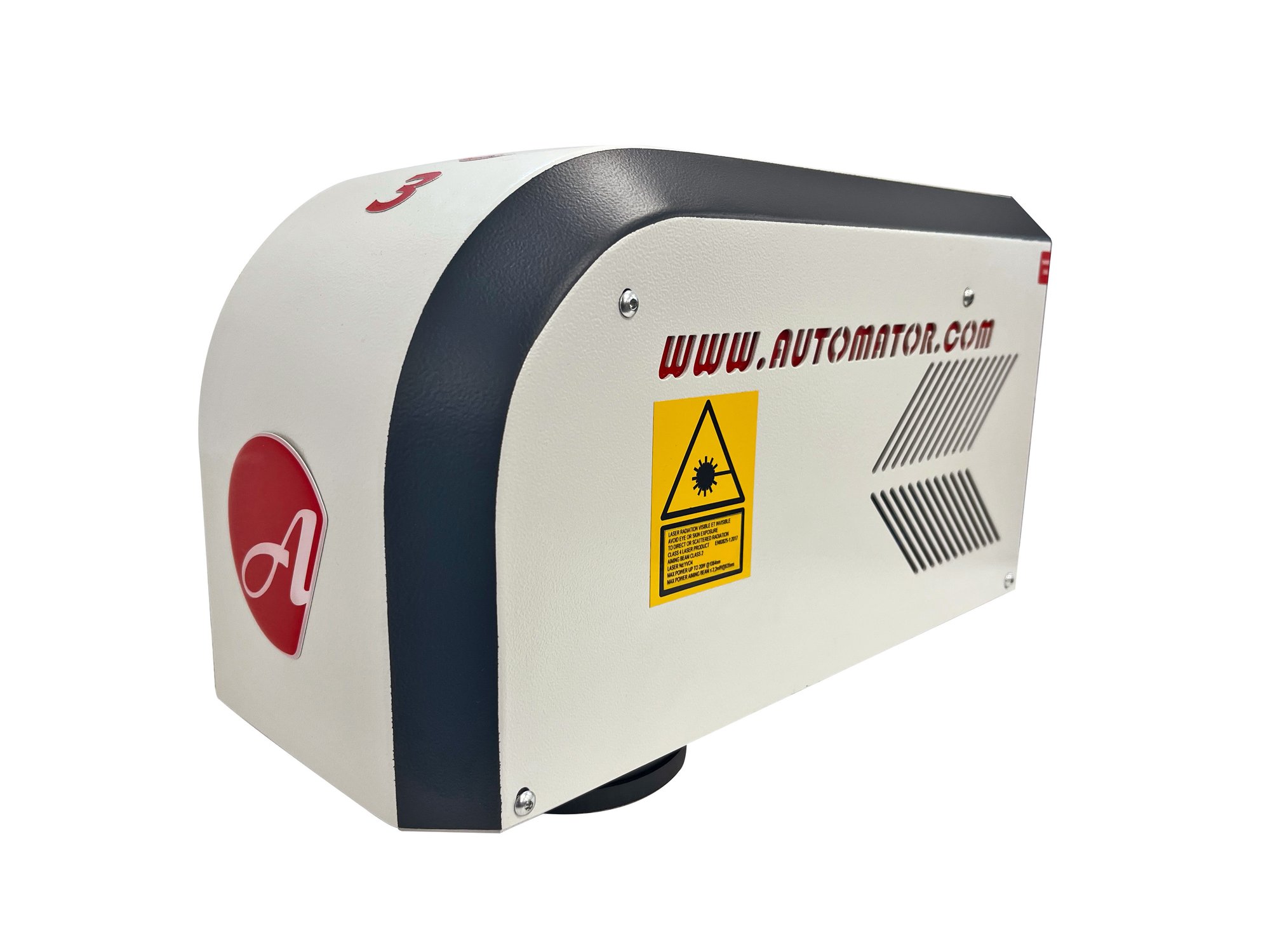
 Laser NANOVIS3 - Class 4

Laser NANOVIS3 - Class 4

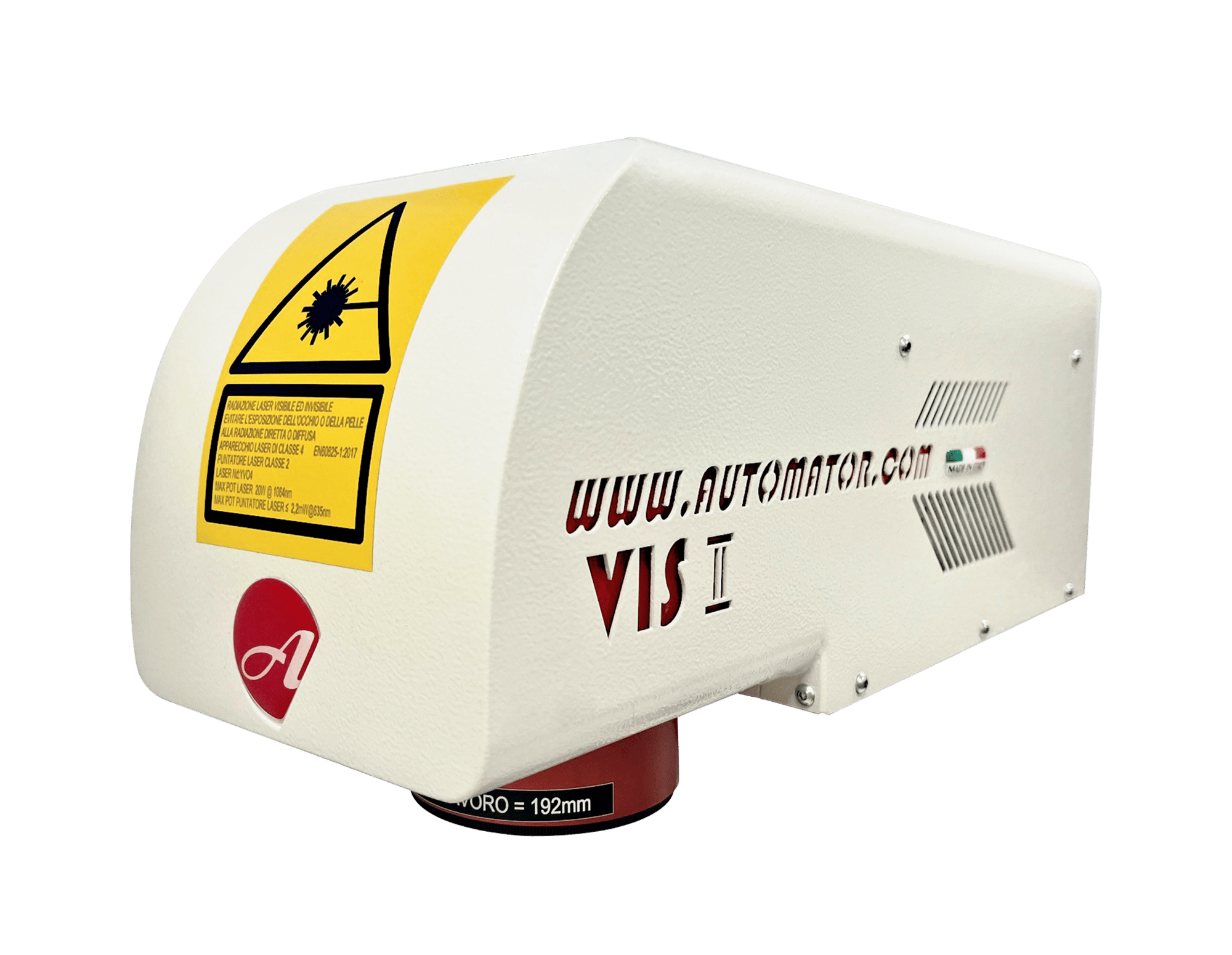
 Laser VISII - 10W 20W 30W - Class 4

Laser VISII - 10W 20W 30W - Class 4

 Laser GREENVISII - 5W 10W - Class 4

Laser GREENVISII - 5W 10W - Class 4

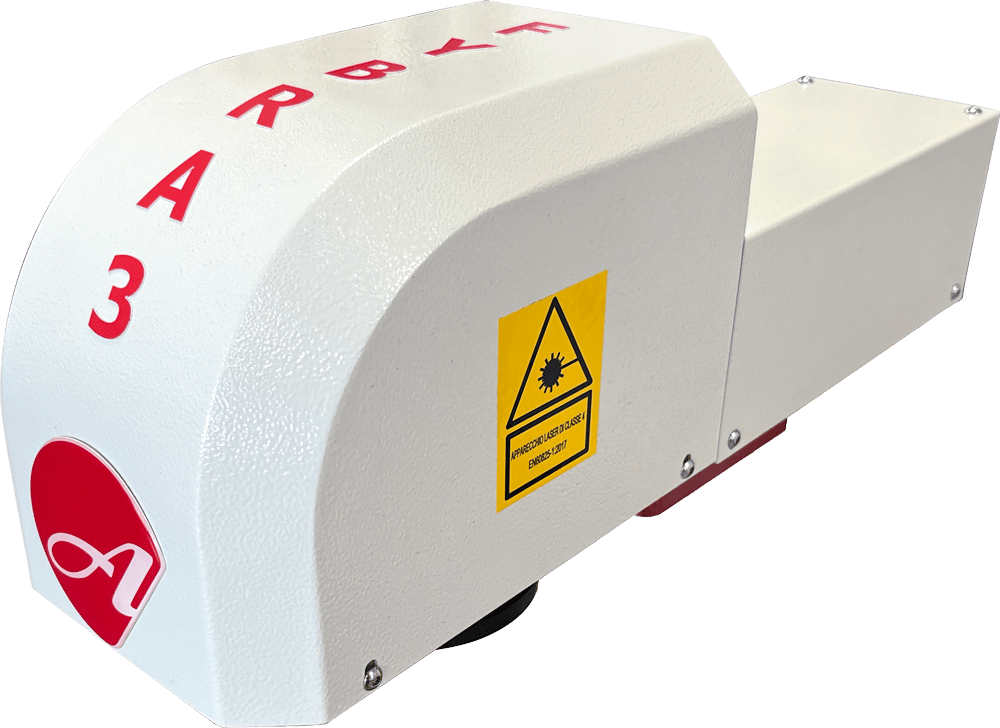
 Laser FYBRA3 - 20W 30W 50W - Class 4

Laser FYBRA3 - 20W 30W 50W - Class 4

How to choose the right laser class for your company

Before deciding, answer a few practical questions. How much floor space do you really have? Does your material need high power, or will a lower-power solution do? Do you have the internal resources (time, budget, staff) to manage Class 4 requirements, or would you rather avoid them altogether?

There is no one-size-fits-all answer: it depends on your volumes, your materials and how much you want to simplify daily safety management. Talking directly with the people who design these machines helps you get the investment right.

With over 85 years in industrial marking and more than 155,000 machines installed worldwide, Automator helps every customer choose the right technology and laser class, before and after purchase.


Frequently asked questions

Can a Class 4 laser become Class 1 by adding guarding?

Yes. A Class 4 source housed in an enclosure that prevents the beam from escaping during normal operation can be classified as a Class 1 laser product. Many benchtop and cabinet marking machines are built on this principle.

Are laser classes the same in every country, or do the rules change from one country to another?

The classification criterion, defined by the IEC 60825-1 standard, is international: a machine's class does not change from one country to another. What can vary are workplace safety obligations, which depend on local legislation.

If I change the material I mark, do I need a new laser hazard evaluation?

Changing material does not change the machine's class, which is a design feature. It may require updating the hazard evaluation if process parameters change, such as power or exposure time.

How much more does a Class 4 laser cost to run over time than a Class 1 laser?

There is no single figure: the extra cost depends on PPE, operator training and designating a Laser Safety Officer. Budget for them at the quote stage, together with the machine price.

Is a Class 4 laser inside a closed robotic cell safe for people in nearby areas?

If the cell is properly interlocked and the beam cannot escape during operation, people in surrounding areas are not exposed. Safety depends on the quality of the guarding installed, not just on having a robotic system.

Contact our team for more information about Automator laser marking machines

Automator Marking Systems S.r.l.

Via Meucci 8, 20094

Corsico (MI) Italy

P. Iva: 12593300960


Tel: + 39 02.48601445

Email: info@automator.com

Fax +39 02.48601503