In this guide, we'll cover:
MOPA stands for “Master Oscillator Power Amplifier”: a main oscillator generates the laser beam, which is then amplified by a separate power stage. This separation between generation and amplification is what sets MOPA apart from a traditional fiber laser, where the two functions are more tightly linked.
In practical terms, for anyone working in production, the difference comes down to one concrete thing: you can adjust not just the laser's power and frequency, but also the duration of each individual pulse, typically between 2 and 350 nanoseconds.
A fiber laser works with fixed-duration pulses: great for deep marking on tough metals, less flexible when you need a delicate or colored result. The MOPA laser adds an extra degree of freedom: by modulating pulse duration, you can go from marks that mimic a classic fiber laser (longer pulses) to marks that behave like a solid-state Nd:YAG laser (shorter pulses), all with the same machine.
All this translates into less overheating of the workpiece during processing, less scorching at the edges of the engraving, and more uniform marking, even on delicate materials like technical plastics.
Neither technology is “better” in absolute terms: the right choice depends on what you need to mark and what result you're after. Here's a direct comparison of the factors that matter most in production.
|
Need |
Traditional fiber laser |
MOPA laser |
|---|---|---|
|
Deep marking on hard metals |
Excellent |
Excellent |
|
Color marking on stainless steel |
Limited |
Excellent |
|
Uniform black on anodized aluminum |
Hard to achieve |
Key strength |
|
Marking on plastics without scorching |
Risk of scorching/fumes |
Significantly reduced |
|
Highly readable UDI codes (medical) |
Good |
Excellent, with lower roughness |
|
Initial investment |
Lower |
Higher, offset by greater versatility |
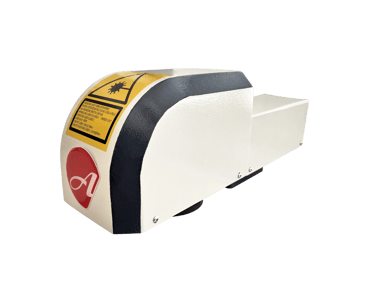
Automator brings this technology into a system built for demanding work environments, where vibration, dust, and continuous use are the norm.
The MOPA3 Laser (Nb:Yb 1064 nm source, 100 W power, Class 4 safety) is a modular system: the main unit keeps the source and the electronic board in separate compartments, so dust entering through the cooling fans never reaches the electronic components. It comes with the dual-channel mechanical shutter described above, for the highest level of safety available on this type of machine.
It's controlled by Automator's EuGENIUS™ software, designed to be used even by people without specific CAD training: