|
Metal
|
Typical use for tags
|
Best marking approach
|
|
Stainless steel
|
Outdoor equipment, marine, food & pharma tags
|
Fiber laser (annealing or engraving)
|
|
Aluminum / anodized aluminum
|
Lightweight asset tags, control panel labels
|
Fiber laser, compact laser
|
|
Brass
|
Valve tags, decorative and heritage tags
|
Laser or Dot Peen
|
|
Steel / carbon steel
|
Structural components, mechanical parts
|
Dot peen, laser
|
|
Titanium
|
Medical and aerospace instrument tags
|
Fiber laser (low thermal impact)
|
|
Copper
|
Electrical and electronic identification tags
|
Low-power laser
|
Stainless steel tags: why it's the preferred choice
Stainless steel is the default choice for tags exposed to outdoor conditions, washdown environments, or chemical contact, because its chromium oxide layer resists corrosion far longer than aluminum or brass.
For tag applications specifically, this matters for two reasons: the tag itself won't corrode away before the equipment it identifies is decommissioned, and laser marking doesn't compromise that corrosion resistance: done correctly, it doesn't breach the passive oxide layer.
Automator's fiber laser systems mark stainless steel through two distinct effects:
- Engraving: removes a thin surface layer for a deep, tactile mark, best where mechanical wear is expected.
- Annealing: uses heat to change the surface oxide color (typically to black) without removing material, preferred where corrosion resistance must stay untouched, e.g. medical or food-contact tags.
Which marking technology is right for your tags?
Choosing the right marking technology for a metal tag depends on the tag's material, the required mark depth, and whether the tag will undergo further processing like painting or plating.
Automator engineers and manufactures every major marking technology used for metal tags:
- Laser marking - non-contact, no consumables, ideal for serial numbers, Data Matrix codes, and logos on stainless steel, aluminum, brass, and most alloys.
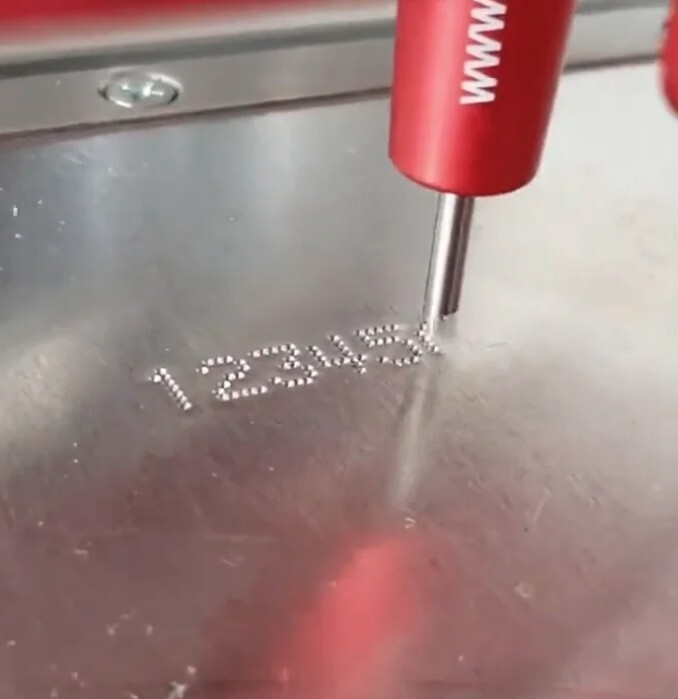
- Dot peen marking - mechanical micro-impacts create a deep, visible mark; well suited if the tag will later be painted or galvanized, since laser marks can be too shallow to survive those treatments.
- Impact marking - simple, fast, and cost-effective for static text on flat tags, using a single strike.
- Roll marking - a rotating die marks continuously; fast and quiet, and one of the few methods well suited to curved or cylindrical tags.
- Scribe marking - a stylus drags across the surface for a deep, silent, continuous mark, often used where noise or vibration from impact methods is a problem.
Why laser is the most common choice for metal tags
Fiber laser technology is the most widely adopted solution for tag marking because it delivers permanent, high-contrast results without touching the material or requiring ink, solvents, or physical tools.
For most tag applications, such as asset tags, nameplates, and equipment ID plates, a fiber laser system gives sharp, repeatable marking at production speed, with zero consumables and minimal maintenance. It's the technology behind most of Automator's dedicated laser marking machines, which cover fixed, compact, and cabin configurations depending on the production setup.
When a tag needs to travel with the operator rather than sit at a workstation, on large equipment, remote installations, or machinery already assembled on site, portable laser marking machines extend the same marking quality outside the production line.
Where metal tag marking matters most
Metal tags marked for traceability and compliance appear across almost every industrial sector, but the requirements shift depending on the environment.
- Equipment and nameplate identification: asset tags, data plates, model/serial number plates on machinery.
- Valve and flange tagging: pressure ratings, standard references, and material grades, often on stainless steel or brass tags exposed to plant environments.
- Oil & gas and heavy industry: tags that must remain legible after years of outdoor exposure, heat, and corrosive agents.
- Automotive and mechanical manufacturing: component ID codes and traceability data, frequently combined with Data Matrix codes.
- Medical and food-grade equipment: stainless steel tags where corrosion resistance and cleanability are non-negotiable.